While I don't write articles on Hearthstone or, for that matter, have
any plans to in the near future, Hearthstone has finished its open beta
and is now "released" (despite being available to play for everyone for
the better part of 3 months). I could gripe about all the issues
introduced with the release patch, nerfs to various cards, gameplay
changes, and so on, but instead I would like to highlight a more general
issue that's bother me for a rather long time.
In the distant past I once posted some suggestions
to improve World of Warcraft's Starter Edition (which I will likely be writing once more in the near future). One of the suggestions
was to allow usage of the Real ID/Battletag system (which I will now
refer to as the Battletag system) if the account the Starter Edition was
attached to could normally access the system due to having a full WoW
account (with an active subscription), Starcraft 2, or Diablo 3. The
implication of this suggestion (and the restrictions in place at the
time) is that the Battletag system is a privilege for paying customers
of Blizzard products. However, a few additions in the recent years threw
this logic completely out of the window.
Based on the
statements about Hearthstone above, the free-to-play card game from
Blizzard makes extensive usage of the Battletag system. In fact, it is mandatory
to create one to play the game at all. Given the fact the game is free
to play and all Starter Editions are also effectively free-to-play, the
consistency of Battletag usage should be the same across all of
Blizzard's games at this point. Furthermore, Diablo 3's Starter Edition
also requires Battletag creation and usage, which was a feature added
close to two years ago (which caused a lot of inevitable soliciting over
the Battletag system that has since died down since it was easy to
ignore anyways). Finally, Heroes of the Storm, another free-to-play game from Blizzard, is likely to end up using the Battletag system as well.
To conclude, it would be great to see Battletags enabled across all games regardless of whether the player is using a Starter Edition or not (in this case, it would apply to the WoW and SC2 Starter Editions). It allows players to retain lines of communication with their friends without any unnecessarily hampering restrictions. In the case of WoW, where it's possible to directly add Battletags by right clicking character portraits, that feature can simply be restricted on Starter Edition accounts to prevent easy soliciting.
Showing posts with label WC3. Show all posts
Showing posts with label WC3. Show all posts
Sunday, March 16, 2014
Thursday, October 10, 2013
Warcraft 3 Reminiscence: Tank Wars/Battletanks
Click here to return to the table of contents.
It's been way too long since I've done this. I don't know how often I'll be updating this particular series (it will receive updates though occasionally) but I did want to discuss a certain map since it seems appropriate to do so. For anyone who's read my articles lately, I like to talk about League of Legends a lot. However, like in the case of some other League of Legends veterans, my MOBA experience dates back to the days of Warcraft 3 back when the MOBA genre was better known as "AoS" or "Aeon of Strife," the map that led to the well-known DotA (that led to what we have now).
However, this article isn't to talk about DotA. While my Warcraft 3 custom map "career" eventually led to playing it, it was long after a few other MOBA-style maps I also played. The first of these was Orcs vs Humans. However, I don't remember enough about the map to write an article about it. The second (set of maps, really), on the other hand, I have plenty of memories of as the play style was and is unique compared to the play style of current MOBAs. It almost blows my mind how a well-known standalone game based on this type of map hasn't been made yet. The maps I am referring to are Tank Wars and Battletanks.
Tank Wars and Battletanks (which I will from here on in refer to as Tank Wars collectively), like other MOBA-style maps, have two set teams with the objective to destroy the other team's base (in this case, the headquarters or equivalent). In order to achieve victory, players have to defeat minions and enemy players while taking control of objectives such as towers or factories (either through destruction or conquest). There are typically also "lanes" that minions go down and towers protect (usually three like DotA or LoL). However, from there on in the differences become apparent.
Unlike in many other MOBAs where players can choose a champion and build items to increase statistics that benefit said champion, in Tank Wars every player starts as a tank pilot (so to speak) with a bit of gold and many vehicle options to choose from. Vehicles have unique sets of abilities along with varying levels of durability. As players advance through a match, they can acquire enough money to upgrade to stronger vehicles.
In addition to this, players have access to stat-boosting items, which is typical of most MOBAs, though upgrades tend to emphasize durability or mobility as opposed to increasing offensive potential. Instead, players can purchase weapons for their tanks with more expensive weapons being more efficient in terms of damage output. Weapons can also have unique traits such as the ability to target only enemy tanks or structures. Since tanks do not typically have a standard method of attack, these weapons function as the tank's ability to deal damage. However, unlike autoattacks from the usual units, weapons autofire, making for different tactical decisions since the autofiring algorithm cannot be controlled directly but with practice can be utilized by players by proper positioning. Weapons can be stacked up and, in the case of later versions of Battletanks, upgraded to a second special tier for a gold cost directly in the player's inventory.
With the way weapons work, a problem is presented in terms of how a player can earn money since creep waves have bounty attached to them. In most versions of Tank Wars, this is resolved by having periodic income that is distributed to all players directly from the computer player on their team (the "player" that controls the creep waves). The size of the income is based on the money that said computer player earned from various bounties along with accumulated gold over time much like all players normally earn. Overall, while this alleviates the problem, proper weapon handling will still separate the great players from the good players because as mentioned before, positioning is key and getting in range to fire on creeps just before they die will usually net the kill gold, which will be more beneficial for the player getting that kill gold.
The various types of Tank Wars maps also feature their own unique traits. For instance, in Battletanks the periodic income is noticeably higher and destroyed towers can be rebuilt at the cost of gold. In Tank Wars Revolution, there are neutral minion camps much like the "jungle" in DotA or LoL with superboss enemies that can drop money and weapons, which are both a boon to the killing team (these usually don't respawn).
Overall, the Tank Wars maps are similar to other MOBAs in some ways but dramatically different in others. The play style that one learns while playing Tank Wars is so different that, as I mentioned before, I feel it's deserving of a standalone game. While it doesn't necessarily have to be themed around tanks (as there are other types of maps like this like Battleship, if I recall correctly), it should retain the gameplay the maps represent. Back during the high point of Warcraft 3 custom play, many Tank Wars tournaments were run much like DotA, though probably on a smaller scale, which is why DotA and maps like it received recognition while maps like Tank Wars didn't.
It's been way too long since I've done this. I don't know how often I'll be updating this particular series (it will receive updates though occasionally) but I did want to discuss a certain map since it seems appropriate to do so. For anyone who's read my articles lately, I like to talk about League of Legends a lot. However, like in the case of some other League of Legends veterans, my MOBA experience dates back to the days of Warcraft 3 back when the MOBA genre was better known as "AoS" or "Aeon of Strife," the map that led to the well-known DotA (that led to what we have now).
However, this article isn't to talk about DotA. While my Warcraft 3 custom map "career" eventually led to playing it, it was long after a few other MOBA-style maps I also played. The first of these was Orcs vs Humans. However, I don't remember enough about the map to write an article about it. The second (set of maps, really), on the other hand, I have plenty of memories of as the play style was and is unique compared to the play style of current MOBAs. It almost blows my mind how a well-known standalone game based on this type of map hasn't been made yet. The maps I am referring to are Tank Wars and Battletanks.
Overview
Tank Wars and Battletanks (which I will from here on in refer to as Tank Wars collectively), like other MOBA-style maps, have two set teams with the objective to destroy the other team's base (in this case, the headquarters or equivalent). In order to achieve victory, players have to defeat minions and enemy players while taking control of objectives such as towers or factories (either through destruction or conquest). There are typically also "lanes" that minions go down and towers protect (usually three like DotA or LoL). However, from there on in the differences become apparent.
Unlike in many other MOBAs where players can choose a champion and build items to increase statistics that benefit said champion, in Tank Wars every player starts as a tank pilot (so to speak) with a bit of gold and many vehicle options to choose from. Vehicles have unique sets of abilities along with varying levels of durability. As players advance through a match, they can acquire enough money to upgrade to stronger vehicles.
In addition to this, players have access to stat-boosting items, which is typical of most MOBAs, though upgrades tend to emphasize durability or mobility as opposed to increasing offensive potential. Instead, players can purchase weapons for their tanks with more expensive weapons being more efficient in terms of damage output. Weapons can also have unique traits such as the ability to target only enemy tanks or structures. Since tanks do not typically have a standard method of attack, these weapons function as the tank's ability to deal damage. However, unlike autoattacks from the usual units, weapons autofire, making for different tactical decisions since the autofiring algorithm cannot be controlled directly but with practice can be utilized by players by proper positioning. Weapons can be stacked up and, in the case of later versions of Battletanks, upgraded to a second special tier for a gold cost directly in the player's inventory.
 |
| In this picture the Swarm Rocket weapons are being utilized to destroy an enemy Cannon Tower. |
The various types of Tank Wars maps also feature their own unique traits. For instance, in Battletanks the periodic income is noticeably higher and destroyed towers can be rebuilt at the cost of gold. In Tank Wars Revolution, there are neutral minion camps much like the "jungle" in DotA or LoL with superboss enemies that can drop money and weapons, which are both a boon to the killing team (these usually don't respawn).
Final Statements
Overall, the Tank Wars maps are similar to other MOBAs in some ways but dramatically different in others. The play style that one learns while playing Tank Wars is so different that, as I mentioned before, I feel it's deserving of a standalone game. While it doesn't necessarily have to be themed around tanks (as there are other types of maps like this like Battleship, if I recall correctly), it should retain the gameplay the maps represent. Back during the high point of Warcraft 3 custom play, many Tank Wars tournaments were run much like DotA, though probably on a smaller scale, which is why DotA and maps like it received recognition while maps like Tank Wars didn't.
Saturday, July 27, 2013
Warcraft 3 Reminiscence: Wilderness Survival
Click here to return to the table of contents.
(It's been awhile since I've done one of these - I've only just now found some time to write one so forgive me)
One thing that I've been a fan of for awhile but haven't talked much about is the concept of survival. Whether it's from books, games, or television shows, I enjoy reading/watching things that have survival-based aspects to it, such as foraging for food to finding shelter to enduring the elements. Even if these parts encompass but a small section of the media in question, I feel that reading or watching said parts allows me to enjoy my experience with the media more (i.e. I'm more likely to read a book that describes the characters trying to survive in the wilderness or something).
Because of this, I was pleasantly surprised when I discovered Wilderness Survival on Warcraft 3.
There were many versions of Wilderness Survival floating about, but while each map had its unique quirks or objectives, such as the ability to tame animals to being a free-for-all where players kill each other instead of working together, each version has some elements common to the entire series of maps.
The first element is a general survival aspect which consists of managing health and your unit's vitals (often shown as temperature, which is usually measured by the character's mana pool). In order to retain vitality, players have to forage for food (either by hunting or gathering). Players also have to build a fire in order to stay warm and potentially cook food.
In order to make a fire and other technological-related objects or structures (such as various weapons, a tent, etc), players have to use a crafting system which can vary but is common to every version of Wilderness Survival. Basic materials will typically be scattered all over the map or can be gathered from the wildlife, both of which randomly replenish themselves periodically. Players then have to have items in a specific sequence in their inventory and use a "craft" spell or the items automatically combine into the craftable item. For instance, to make a fire in most wilderness survival games, players need to get some wood, stones, and flint and place them in the first three inventory slots, then use the "craft" spell.
The final element of Wilderness Survival is a snowy tileset (usually) to emphasize how hard it is to survive in the map.
Overall, the concept of Wilderness Survival maps is seemingly simple but can turn out to be shockingly complicated depending on the map's objectives and crafting system.
Wilderness Survival was a fun map if I ever managed to catch it being hosted, since players rarely hosted the map. While it took awhile to figure out each version's crafting system and objectives, fighting to keep my unit alive was a blast. Unfortunately, these maps are almost never hosted anymore, which is upsetting (though there are some similar maps that do get hosted occasionally). However, some developers have realized the potential of a video game featuring significant levels of survivalist elements. One excellent example of this is the game Don't Starve.
(It's been awhile since I've done one of these - I've only just now found some time to write one so forgive me)
One thing that I've been a fan of for awhile but haven't talked much about is the concept of survival. Whether it's from books, games, or television shows, I enjoy reading/watching things that have survival-based aspects to it, such as foraging for food to finding shelter to enduring the elements. Even if these parts encompass but a small section of the media in question, I feel that reading or watching said parts allows me to enjoy my experience with the media more (i.e. I'm more likely to read a book that describes the characters trying to survive in the wilderness or something).
Because of this, I was pleasantly surprised when I discovered Wilderness Survival on Warcraft 3.
Overview
There were many versions of Wilderness Survival floating about, but while each map had its unique quirks or objectives, such as the ability to tame animals to being a free-for-all where players kill each other instead of working together, each version has some elements common to the entire series of maps.
The first element is a general survival aspect which consists of managing health and your unit's vitals (often shown as temperature, which is usually measured by the character's mana pool). In order to retain vitality, players have to forage for food (either by hunting or gathering). Players also have to build a fire in order to stay warm and potentially cook food.
In order to make a fire and other technological-related objects or structures (such as various weapons, a tent, etc), players have to use a crafting system which can vary but is common to every version of Wilderness Survival. Basic materials will typically be scattered all over the map or can be gathered from the wildlife, both of which randomly replenish themselves periodically. Players then have to have items in a specific sequence in their inventory and use a "craft" spell or the items automatically combine into the craftable item. For instance, to make a fire in most wilderness survival games, players need to get some wood, stones, and flint and place them in the first three inventory slots, then use the "craft" spell.
The final element of Wilderness Survival is a snowy tileset (usually) to emphasize how hard it is to survive in the map.
 |
| An example of the typical snowy Wilderness Survival map layout. |
Final Words
Wilderness Survival was a fun map if I ever managed to catch it being hosted, since players rarely hosted the map. While it took awhile to figure out each version's crafting system and objectives, fighting to keep my unit alive was a blast. Unfortunately, these maps are almost never hosted anymore, which is upsetting (though there are some similar maps that do get hosted occasionally). However, some developers have realized the potential of a video game featuring significant levels of survivalist elements. One excellent example of this is the game Don't Starve.
Monday, July 8, 2013
Warcraft 3 Reminiscence: Castle Defense
Click here to return to the table of contents.
While Vampirism was fun and all and messing around in the various tower defense or tower defense oriented maps was an enjoyable side activity, I wanted to try other defense maps that didn't just involve building a bunch of towers. While there were some maps that met this criteria later, the first defense map I played that was oriented towards the usage of heroes and units was Castle Defense.
In Castle Defense, the objective is to work with up to seven other players to defend the "King" of the castle, an NPC in the middle, from oncoming waves of enemies. In order to accomplish this objective, you are given some units (such as archers and footman) and the ability to create more units and heroes. In later versions, an upgradable tower was also added.
This game was essentially a basic defense game with units. There were a variety of strategies involved, such as standing ground with archers/other ranged units on the walls and melee units at the entrance. However, given that in most of the versions there wasn't too much of a constructed defense besides that gate that led to the King's room, it was easiest to have all the players gather their units in the King's room since it was easily defended with a large mass of archers and ranged heroes.
Most heroes use their basic skill sets from the standard game, though later versions featured unique heroes (or at least unique skill sets). There are also shops to gear up heroes if so desired. Summoning and healing skills are typically helpful on Castle Defense because of the limited amount of units you have, though this can be increased by hiring or building more units as the game goes on, since enemies have bounty.
Overall, the map is pretty simple. Like in any defense game, the players have to survive all the waves to win. I believe like in other defense games there were some gimmicks (such as boss waves, etc), though they were notably less prevalent on this map.
There's not really too much to say about Castle Defense. It was a pretty simple defense map that didn't particularly change a lot of the basic Warcraft 3 unit data. In a lot of the older versions it essentially was a melee defense map. Later versions featured new castle architecture (which I wasn't particularly a fan of because it either made the map too easy or too hard to defend) and the addition of defensive structures, though for some reason barricades never really made it into the game.
While the map was fun to play, the simplicity of it eventually tired me out and I went in search of bigger and better things.
While Vampirism was fun and all and messing around in the various tower defense or tower defense oriented maps was an enjoyable side activity, I wanted to try other defense maps that didn't just involve building a bunch of towers. While there were some maps that met this criteria later, the first defense map I played that was oriented towards the usage of heroes and units was Castle Defense.
Overview
In Castle Defense, the objective is to work with up to seven other players to defend the "King" of the castle, an NPC in the middle, from oncoming waves of enemies. In order to accomplish this objective, you are given some units (such as archers and footman) and the ability to create more units and heroes. In later versions, an upgradable tower was also added.
 |
| The castle you have to defend (also a splash image for one of the versions of Castle Defense, since Warcraft 3 uses the map as the splash if a custom one isn't set) |
Most heroes use their basic skill sets from the standard game, though later versions featured unique heroes (or at least unique skill sets). There are also shops to gear up heroes if so desired. Summoning and healing skills are typically helpful on Castle Defense because of the limited amount of units you have, though this can be increased by hiring or building more units as the game goes on, since enemies have bounty.
Overall, the map is pretty simple. Like in any defense game, the players have to survive all the waves to win. I believe like in other defense games there were some gimmicks (such as boss waves, etc), though they were notably less prevalent on this map.
Final Words
There's not really too much to say about Castle Defense. It was a pretty simple defense map that didn't particularly change a lot of the basic Warcraft 3 unit data. In a lot of the older versions it essentially was a melee defense map. Later versions featured new castle architecture (which I wasn't particularly a fan of because it either made the map too easy or too hard to defend) and the addition of defensive structures, though for some reason barricades never really made it into the game.
While the map was fun to play, the simplicity of it eventually tired me out and I went in search of bigger and better things.
Tuesday, June 25, 2013
Warcraft 3 Reminiscence: Teamline Tower Wars (TLTW)
Click here to return to the table of contents.
During the time I played Vampirism Revolution and Vampirism 7.5/7.9, I also was a regular player of several other maps. While some were similar to the format of Vampirism or spinoff maps, others were original works or derivatives of map formats I had yet to experience. Some of my fondest memories, especially since I played Warcraft III customs alongside my brother, were from Teamline Tower Wars (shortened as TLTW), specifically version 1.5.
Teamline Tower Wars is very similar to Tower Defense maps that require you to maze like Wintermaul. Each two-person team is given a long stretch of area to build their towers on and have to hold off waves of enemies sent by the preceding team which spawn in a small region at the top of the team's area. For each enemy that manages to leak through, the team loses a life and the team that sent the minions gains a life. The minion then goes on to challenge the next team's defenses. If a team runs out of lives and is defeated, minions sent will go to the team following it instead. To prevent blocking, anti-cheat NPCs that destroy towers that block waves patrol about the map.
As mentioned above, teams also control the flow of units that the following team will deal with. The team has to be able to afford to send the unit and enough time has to have passed in order to send stronger units (no sending tier 3 attacking units at the start, lol). Sending units will (usually) increase the team's income, though stronger units give less income per gold than weaker units. Income is given every 15 seconds or so and should be built up as much as possible to get access to stronger towers and units.
By the endgame, gold will reach the one million cap and can be spent in lots of 100,000 for a piece of lumber. Lumber can be used to research high tier towers (of which each player can research four of by default, meaning a team can potentially have eight different techs at the start) or to send endgame units.
Given the two objectives, players usually call either the role of sender or builder. The sender focuses on sending units from the beginning of the game to build the team's income while also trying to steal lives. Later on the sender typically assists in defending by building some support towers such as towers that provide a large splashing slow attack. The builder, which I personally favored, builds the defenses and uses excess income to send units later on. This is especially devastating since the builder can accumulate a lot of money and send a huge amount of units along with the sender's usual payload (or, if you're really coordinated and premake with your teammate, you can send even more by having the sender save up). The builder usually focuses on creating damage towers.
Units that could be sent sometimes had special abilities. For instance, some can fly, others have the ability to attack the towers, and the endgame creatures can have even more (regeneration aura, invisibility, etc). Towers also had special effects, mostly the tech ones. For instance, as mentioned before, there is a tower that specializes in slowing huge amounts of enemies with a ridiculous splash radius. Higher tier towers can also grant true sight.
Teamline Tower Wars was a fun map to play. I enjoyed the strategy required to be the superior team and when me and my brother played, we were pretty much unmatched. Also, in some of the older maps there's a hilarious cheat that can give the Red player one million gold whenever they want which pretty much broke the game. There was also a single-player version called Line Tower Wars where people competed against either other and had to manage both defending and sending. Personally I never really liked that one as much because my ability to micro sucked and the tech levels are a lot lower in that map.
During the time I played Vampirism Revolution and Vampirism 7.5/7.9, I also was a regular player of several other maps. While some were similar to the format of Vampirism or spinoff maps, others were original works or derivatives of map formats I had yet to experience. Some of my fondest memories, especially since I played Warcraft III customs alongside my brother, were from Teamline Tower Wars (shortened as TLTW), specifically version 1.5.
Overview
Teamline Tower Wars is very similar to Tower Defense maps that require you to maze like Wintermaul. Each two-person team is given a long stretch of area to build their towers on and have to hold off waves of enemies sent by the preceding team which spawn in a small region at the top of the team's area. For each enemy that manages to leak through, the team loses a life and the team that sent the minions gains a life. The minion then goes on to challenge the next team's defenses. If a team runs out of lives and is defeated, minions sent will go to the team following it instead. To prevent blocking, anti-cheat NPCs that destroy towers that block waves patrol about the map.
As mentioned above, teams also control the flow of units that the following team will deal with. The team has to be able to afford to send the unit and enough time has to have passed in order to send stronger units (no sending tier 3 attacking units at the start, lol). Sending units will (usually) increase the team's income, though stronger units give less income per gold than weaker units. Income is given every 15 seconds or so and should be built up as much as possible to get access to stronger towers and units.
By the endgame, gold will reach the one million cap and can be spent in lots of 100,000 for a piece of lumber. Lumber can be used to research high tier towers (of which each player can research four of by default, meaning a team can potentially have eight different techs at the start) or to send endgame units.
Given the two objectives, players usually call either the role of sender or builder. The sender focuses on sending units from the beginning of the game to build the team's income while also trying to steal lives. Later on the sender typically assists in defending by building some support towers such as towers that provide a large splashing slow attack. The builder, which I personally favored, builds the defenses and uses excess income to send units later on. This is especially devastating since the builder can accumulate a lot of money and send a huge amount of units along with the sender's usual payload (or, if you're really coordinated and premake with your teammate, you can send even more by having the sender save up). The builder usually focuses on creating damage towers.
Units that could be sent sometimes had special abilities. For instance, some can fly, others have the ability to attack the towers, and the endgame creatures can have even more (regeneration aura, invisibility, etc). Towers also had special effects, mostly the tech ones. For instance, as mentioned before, there is a tower that specializes in slowing huge amounts of enemies with a ridiculous splash radius. Higher tier towers can also grant true sight.
 |
| Example of a (suboptimal) defense. Note that this is a later version. |
Final Words
Teamline Tower Wars was a fun map to play. I enjoyed the strategy required to be the superior team and when me and my brother played, we were pretty much unmatched. Also, in some of the older maps there's a hilarious cheat that can give the Red player one million gold whenever they want which pretty much broke the game. There was also a single-player version called Line Tower Wars where people competed against either other and had to manage both defending and sending. Personally I never really liked that one as much because my ability to micro sucked and the tech levels are a lot lower in that map.
Friday, June 14, 2013
Warcraft 3 Reminiscence: Vampirism (7.5, 7.9)
Click here to return to the table of contents.
After being introduced to the Vampirism scene, I spent a lot of time playing similar versions of Vampirism maps when I could. While I did try other custom maps out as well (I'll go over these later), it was obvious that playing Vampirism was my forte and epic play after epic play piled before me and the friends I played with. During my hunt through the custom map list, I came across another version of Vampirism that was much like the Vampirism Revolution I'd play a majority of the time, but with significant extensions. This map was simply known as "Vampirism 7.5" and later on, "Vampirism 7.9."
In many ways, this map is similar to Vampirism Revolution. Most of the structures and technology for the Human builders is retained and core mechanics that are common to Vampirism remain in place. However, besides the new terrain, there are some major differences, as listed below.
As mentioned in the facts above, this map was a very influential piece of work with numerous mechanics making their way into later Vampirism maps. However, the map in itself was full of balance issues.
This is mostly because human basing spots are not created even remotely equal. There's like two or three good base spots and the rest are inferior by comparison. The infamous "top left" spot, as shown below, was rapidly considered the strongest spot since one could build enormous amounts of Long Towers (easily over 50) and cut down the Vampires before they can touch the walls, which can go as many as 10 or more layers deep before even reaching the main base area, which is a good many layers deeper than most other bases can allow for.
To make things worse, stalemates can happen because a Human can constantly juke a single Vampire for pretty much eternity with proper Blink usage since there are places the Vampire cannot reach (though they do have ranged nuking abilities which essentially ensures the Human has to keep moving).
While the map was slated a bit against Vampires, the new items they could get, as well as Human-built Feeding Blocks in 7.9, helped to keep a game going. Nothing beats trying to hold against a Nosferatu with 6 Dracula Helms.
After being introduced to the Vampirism scene, I spent a lot of time playing similar versions of Vampirism maps when I could. While I did try other custom maps out as well (I'll go over these later), it was obvious that playing Vampirism was my forte and epic play after epic play piled before me and the friends I played with. During my hunt through the custom map list, I came across another version of Vampirism that was much like the Vampirism Revolution I'd play a majority of the time, but with significant extensions. This map was simply known as "Vampirism 7.5" and later on, "Vampirism 7.9."
Overview
In many ways, this map is similar to Vampirism Revolution. Most of the structures and technology for the Human builders is retained and core mechanics that are common to Vampirism remain in place. However, besides the new terrain, there are some major differences, as listed below.
- The first biggest difference is the main builder has the Blink ability, allowing them to teleport a short distance. This was actually explored in earlier iterations of other Vampirism maps though usually it was a long-cooldown escape. In this case, Blink has a short cooldown and costs 1 mana, but the builder has only 2 mana and doesn't regenerate it fast enough to sustain endless Blink usage. While this will allow the builder to escape hairy situations or leave the base to build, it can't be relied on to evade vampires forever.
- Speaking of vampires, the game starts with two Nosferatu, with Dracula completely removed. This becomes a staple in the later Vampirism maps. The skill set is also slightly altered.
- Vampires gain access to some new items and the secret recipes (from Revolution) are nonexistent. The one major item worth noting is the Dracula Helm, which increases Health and Damage by a staggering amount (3000 Health, 300 Damage), but they are rather costly.
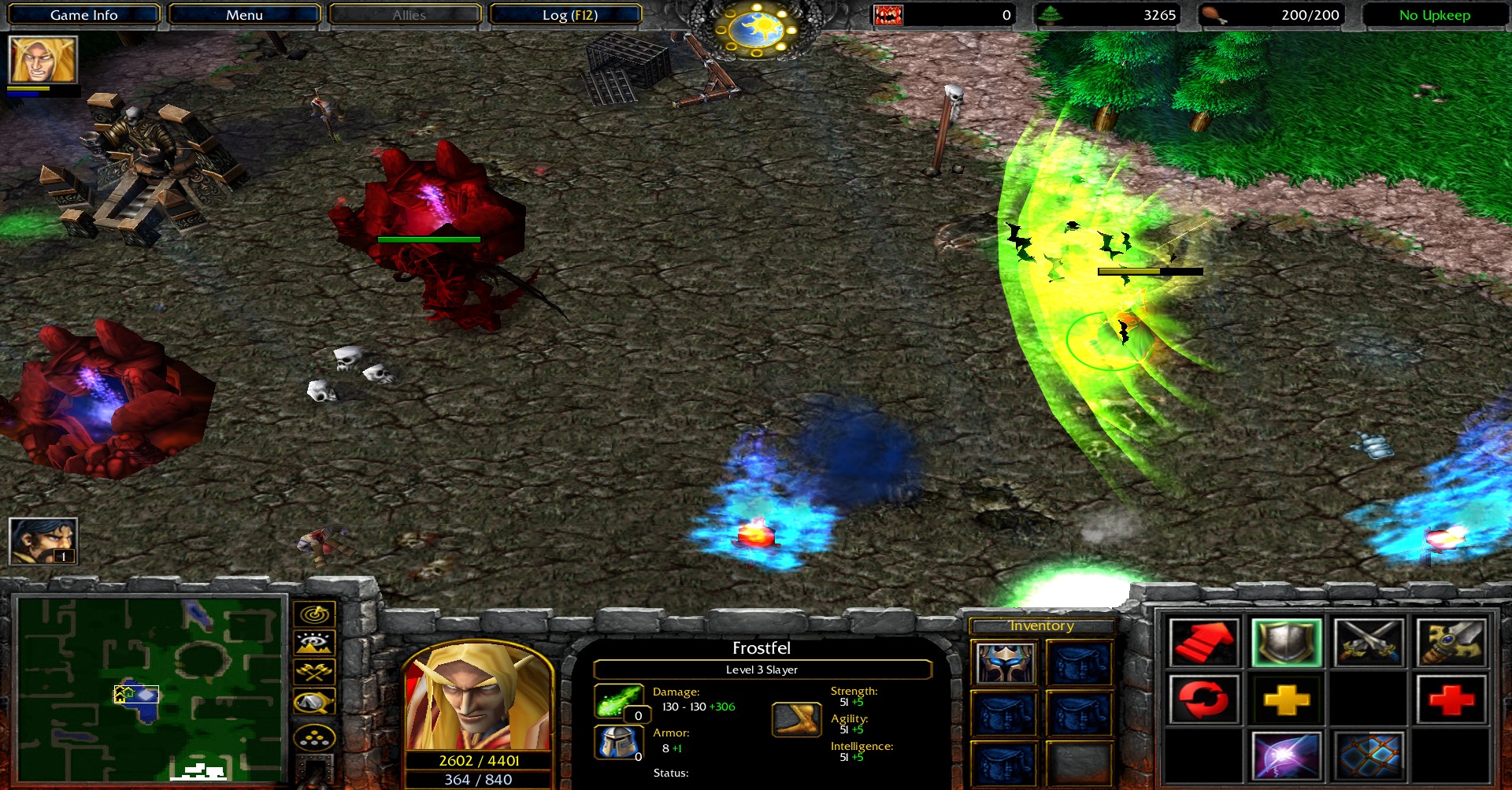 |
| Slayer with a Dracula Helm. Note that this could never happen in a real match. |
- Humans gain access to some additional technology, specifically the Long Tower structure. Other technology, such as the true sight, have been removed.
- Slayers now have a global Blink on a short cooldown (as opposed to a short-ranged, long cooldown blink like in Vampirism Revolution). In addition, there's an area known as the "slayer fountain" where Slayers that patrol around in it gain a level every minute up to the level cap of 13.
 |
| The "Slayer fountain" that became a staple in later Vampirism maps. Note that Slayers start at level 2. |
This is mostly because human basing spots are not created even remotely equal. There's like two or three good base spots and the rest are inferior by comparison. The infamous "top left" spot, as shown below, was rapidly considered the strongest spot since one could build enormous amounts of Long Towers (easily over 50) and cut down the Vampires before they can touch the walls, which can go as many as 10 or more layers deep before even reaching the main base area, which is a good many layers deeper than most other bases can allow for.
 |
| An example of why this base spot was absurd. Note that there are more Long Towers (they look like the normal Human towers while the Spike Towers, shown as Orc Water Towers, are short range) above and below as well. |
Final Words
While the map was slated a bit against Vampires, the new items they could get, as well as Human-built Feeding Blocks in 7.9, helped to keep a game going. Nothing beats trying to hold against a Nosferatu with 6 Dracula Helms.
Monday, June 3, 2013
Warcraft 3 Reminiscence: Vampirism Revolution (9.7)
Click here to return to the table of contents.
After being introduced to the world of custom maps, I went about, playing whatever I could find. Within a matter of a week I'd screwed up so many custom games by being a total newbie and doing everything that could be done wrong in any given map was done. However, in a short time I gravitated towards maps with a survival type of feel. Maybe it's because I enjoyed the hero survival scenarios when playing through the Warcraft III campaigns or I generally find survival (especially wilderness survival) games interesting due to their frantic nature. Regardless, I gravitated towards a map, or rather series of maps, known universally as Vampirism, with Vampirism Revolution serving as the starting point of gaming experiences I remember fondly.
This map's objectives differ greatly depending on whether the player is a Human or a Vampire. As a Human, of which there are up to 10 of at the start, the objective is to build structures, gather lumber (the primary resource in this game), research, and construct defenses in the form of upgradable towers and walls (in this map there was only one of each "type") and hold off the Vampire(s) and try to survive. 15 minutes after the Vampire initially spawns, Human players will receive one gold and get access to stronger technology by building the Slayer's Vault structure, though slaying a Vampire also awards one gold, allowing access to the Slayer's Vault earlier. Humans can also summon a hero called the Slayer, who can help kill the Vampire and pick up the hearts they drop upon death to gain levels and stats (though they cannot be dropped after).
The starting Vampire can choose between either being a Nosferatu or Dracula, which have different playstyles and abilities. The Nosferatu excels at dealing high amounts of damage through hard-hitting strikes and can eventually gain an ultimate ability that allows him to immolate nearby structures (at the cost of Mana). The Dracula hits fast as opposed to hard, can summon a clone of himself to assist in sieges or surrounding Humans, and gains permanent invisibility as his ultimate ability. As a Vampire, the objective is to kill the Human builders (who subsequently become lesser Vampires with weaker abilities and overall power). Vampires have access to skill sets that allow them to hunt the Humans, ranging from the Far Sight ability to reveal the map (though this has a long cooldown), Wind Walk to sneak up on enemies (though Humans eventually can research true sight), and healing/nuking spells to help out in a siege or strike down enemies from afar.
Vampire(s) gain gold for destroying structures and killing Human players. They will also gain a small amount over time (as well as other assistance, such as revealing Human structures and gaining experience as the "gold penalty" of 15 minutes approaches). The gold can be spent at a shop in the center to buy items that help the Vampire(s). Buying specific items together can access special, stronger items if they are brought to the Vampire spirit also in the center of the map. The center area is also used for healing.
The game ends when either all the Vampires or all the Humans are slain. In general, as time goes on, the Humans will gain the advantage as they gain more and more resources.
Beyond that, there's not much to say. There's numerous variants on this type of map where many defend against the few and the level of enjoyment varies depending on how well-designed the map terrain is, how well-balanced the map is, and how popular the map is. While Vampirism Revolution wasn't the only Vampirism map I played (there were several older versions as well), it stuck out to me because of its high popularity and reasonable level of balance between Vampire and Human. While the lack of technology levels and small leap between early, mid, and endgame stick out nowadays compared to the more "advanced" Vampirism maps and others like it, Vampirism Revolution was around in a simpler time.
However, despite the fact I played against the creator (and lost horribly) and had some epic moments as both a Human and Vampire player, it doesn't even remotely match up to what was to come in the Vampirism scene.
After being introduced to the world of custom maps, I went about, playing whatever I could find. Within a matter of a week I'd screwed up so many custom games by being a total newbie and doing everything that could be done wrong in any given map was done. However, in a short time I gravitated towards maps with a survival type of feel. Maybe it's because I enjoyed the hero survival scenarios when playing through the Warcraft III campaigns or I generally find survival (especially wilderness survival) games interesting due to their frantic nature. Regardless, I gravitated towards a map, or rather series of maps, known universally as Vampirism, with Vampirism Revolution serving as the starting point of gaming experiences I remember fondly.
Overview
 |
| Awesome loading screen is awesome. |
The starting Vampire can choose between either being a Nosferatu or Dracula, which have different playstyles and abilities. The Nosferatu excels at dealing high amounts of damage through hard-hitting strikes and can eventually gain an ultimate ability that allows him to immolate nearby structures (at the cost of Mana). The Dracula hits fast as opposed to hard, can summon a clone of himself to assist in sieges or surrounding Humans, and gains permanent invisibility as his ultimate ability. As a Vampire, the objective is to kill the Human builders (who subsequently become lesser Vampires with weaker abilities and overall power). Vampires have access to skill sets that allow them to hunt the Humans, ranging from the Far Sight ability to reveal the map (though this has a long cooldown), Wind Walk to sneak up on enemies (though Humans eventually can research true sight), and healing/nuking spells to help out in a siege or strike down enemies from afar.
Vampire(s) gain gold for destroying structures and killing Human players. They will also gain a small amount over time (as well as other assistance, such as revealing Human structures and gaining experience as the "gold penalty" of 15 minutes approaches). The gold can be spent at a shop in the center to buy items that help the Vampire(s). Buying specific items together can access special, stronger items if they are brought to the Vampire spirit also in the center of the map. The center area is also used for healing.
The game ends when either all the Vampires or all the Humans are slain. In general, as time goes on, the Humans will gain the advantage as they gain more and more resources.
Final Words
Beyond that, there's not much to say. There's numerous variants on this type of map where many defend against the few and the level of enjoyment varies depending on how well-designed the map terrain is, how well-balanced the map is, and how popular the map is. While Vampirism Revolution wasn't the only Vampirism map I played (there were several older versions as well), it stuck out to me because of its high popularity and reasonable level of balance between Vampire and Human. While the lack of technology levels and small leap between early, mid, and endgame stick out nowadays compared to the more "advanced" Vampirism maps and others like it, Vampirism Revolution was around in a simpler time.
However, despite the fact I played against the creator (and lost horribly) and had some epic moments as both a Human and Vampire player, it doesn't even remotely match up to what was to come in the Vampirism scene.
Sunday, May 19, 2013
Warcraft 3 Reminiscence: Liquid Tower Defense
Click here to return to the table of contents.
When I started playing Warcraft 3 a long time ago, my first experience was with a friend who already had the game. After watching him for a bit I asked if I could have a go and he finds me a random custom map to play. This map happened to be Liquid Tower Defense.
When I started playing Warcraft 3 a long time ago, my first experience was with a friend who already had the game. After watching him for a bit I asked if I could have a go and he finds me a random custom map to play. This map happened to be Liquid Tower Defense.
Overview
While it's nothing special nowadays, Liquid Tower Defense was the first map to introduce me to one of the typical "tower defense" formulas. It featured specific areas where a player is designated to build, multiple builder types to choose from, and the typical wave after wave of enemies that must be stopped before they reach the end.
Later on, Liquid Tower Defense innovated by adding multiple spawn points with smaller waves so every player gets a piece of the action and doesn't end up gold-starved purely because they either couldn't kill enough of the larger waves in previous versions or didn't get enough to kill because they were the "last builder," (though there was a slight gold compensation to the last builder to make up for it) which meant their towers stopped any "leaks" that other players had, which could mean they get nothing to kill at all. It also made each wave noticeably faster, making Liquid Tower Defense games faster.
Final Words
While my first game on the match rapidly descended into trolling the other players by making towers in their spots, Liquid Tower Defense would lead to me playing many more TDs until I eventually found I enjoyed another specific type of map.
Beyond that, there's not really much else to say. When it comes down to it, Liquid Tower Defense is simply another "TD" map. It might be worth a try if you're willing to play solo as the "last builder" much like Skibi's, since this map is rarely, if ever, hosted.
Sorry, no screenshot for this one.
Sorry, no screenshot for this one.
Friday, May 10, 2013
Warcraft 3 Reminiscence: Skibi's Castle TD
Click here to return to the table of contents.
Skibi's Castle TD (Tower Defense) is a custom map "made" (official) by Blizzard. It is automatically downloaded with the game (if it's not in the directory just attempt to connect to Battle.net and a downloaded patch will add this map to the directory). It is intended for up to 10 players, with 5 on each "side" of the map, though the map works with a single 5-player team as well.
Like any tower defense map, the objective is to build towers in order to defeat waves of enemies that will eventually destroy the structure you're trying to defend (in this case, it's Skibi's castle, as the game name implies). Skibi's Castle TD also has difficulty levels that influence how strong enemies are.
Like most tower defenses, this map uses "lives," meaning that when an enemy gets through to Skibi's castle, the team loses a life until all lives are expended, though there are bonus levels with extremely durable enemies that don't expend lives if they make it through.
Like the previous description implies, Skibi's Castle TD plays like most other tower defenses, with diverse builder choices (a player can have multiple builders, but the first builder determines access to special structures as well as a unique passive related to the builder), air levels that challenge whether the team has made sufficient aerial defenses, boss waves (every 5 waves) with tough enemies with special perks, and so on. Skibi's Castle TD features some unique wave perks such as enemies that move faster over time, exploding monsters, and monsters that damage towers with an immolating aura, forcing the player to heal the towers. However, this is only part of Skibi's Castle TD.
The other part of the map is the minigames, where players can farm gold (if they're playing Classic/Impossible mode) or have fun (if they chose the Minigame mode). Doing well in a given minigame will award more gold, though some are competitive, often pitting the two teams (if there are two) against each other.
Overall, the map is pretty decent. However, I rarely saw it hosted (honestly the only "Blizzard" map I saw hosted by players frequently was "Worm War," which I never played) and the only time I bothered with it was when I wanted to play something by myself because of a lack of internet. To be fair, however, it was time well spent. If you have a copy of Warcraft III (it should be available with or without the expansion) and you like tower defenses, I'd say try this one out.
Skibi's Castle TD (Tower Defense) is a custom map "made" (official) by Blizzard. It is automatically downloaded with the game (if it's not in the directory just attempt to connect to Battle.net and a downloaded patch will add this map to the directory). It is intended for up to 10 players, with 5 on each "side" of the map, though the map works with a single 5-player team as well.
 |
| Choose your difficulty! |
Description
Like any tower defense map, the objective is to build towers in order to defeat waves of enemies that will eventually destroy the structure you're trying to defend (in this case, it's Skibi's castle, as the game name implies). Skibi's Castle TD also has difficulty levels that influence how strong enemies are.
Like most tower defenses, this map uses "lives," meaning that when an enemy gets through to Skibi's castle, the team loses a life until all lives are expended, though there are bonus levels with extremely durable enemies that don't expend lives if they make it through.
Like the previous description implies, Skibi's Castle TD plays like most other tower defenses, with diverse builder choices (a player can have multiple builders, but the first builder determines access to special structures as well as a unique passive related to the builder), air levels that challenge whether the team has made sufficient aerial defenses, boss waves (every 5 waves) with tough enemies with special perks, and so on. Skibi's Castle TD features some unique wave perks such as enemies that move faster over time, exploding monsters, and monsters that damage towers with an immolating aura, forcing the player to heal the towers. However, this is only part of Skibi's Castle TD.
The other part of the map is the minigames, where players can farm gold (if they're playing Classic/Impossible mode) or have fun (if they chose the Minigame mode). Doing well in a given minigame will award more gold, though some are competitive, often pitting the two teams (if there are two) against each other.
Final Words
Friday, May 3, 2013
New Article Series: Warcraft III Custom Map Overviews!
While it's all too apparent nowadays, I don't particularly have too many article ideas, especially ones I can realistically write at the moment. I do have several planned, but most are essentially the equivalent of long-term projects. In addition, while working my way to Platinum ELO on League of Legends and struggling to keep myself relevant gear-wise in World of Warcraft, I don't have as much time as I'd like to get said projects done, thus limiting me to short articles if I want to even publish anything in a given week.
Because the World of Warcraft Newbie Guide series is coming to a close (for now, at least, mostly because I can't think of much more a newbie would need to know prior to the level cap) and to help alleviate the issue I mentioned above, I am going to start writing short articles about the Warcraft III custom game scene. These articles will recount my experiences with specific, memorable maps.
Many of these maps were games in themselves and, in my opinion, would make excellent standalone games. In addition to potentially promoting the creation of standalone games based off custom maps (that aren't DotA), I also hope to help either revive the dying Warcraft III custom game scene or promote the creation of some of these maps for Starcraft II to promote that custom game scene instead.
With that, I introduce the Warcraft III Reminiscence Series!
Below this point is a table of contents containing maps I have reviewed:
Skibi's Castle TD
Liquid Tower Defense
Vampirism Revolution (9.7)
Vampirism 7.5/7.9
Teamline Tower Wars (TLTW)
Castle Defense
Wilderness Survival
Tank Wars/Battletanks
Subscribe to:
Posts (Atom)