The WoW Token is a feature that I think has been largely beneficial to the game to the point that I would defend certain aspects of it, such as the fact it may be considered "pay to win", pretty strongly. However, while I should be very biased considering I've paid for game time using the feature for over two years and converted more to hundreds of dollars of Battle.net balance, I'm not against the idea of criticizing it in some respects. For instance, I mentioned pretty early on that it might not end up reaching parts of the target audience since they literally would not be able to buy it with gold, at least not without wasting the time of a customer service rep. As of this writing, this issue has still not been addressed.
However, another issue I could've brought up even during the early stages of the WoW Token system but refrained from is the poor conversion rate considering that in the U.S., $20 of WoW Token buys $15 or less of game time. When Blizzard updated the WoW Token to be able to convert into Battle.net balance it served as great boon especially to players with little disposable income, but also showed how transparent the 33% markup was. The markup is even worse with certain other currencies. For example, based on info from this site, €20 converts into €13 of Battle.net balance and £15 converts into £10 of Battle.net balance. While I did briefly tweet about this issue, it doesn't particularly do justice when it comes to discussing the topic and why I find the markup to be problematic for Blizzard in at least a couple of ways. Therefore, this article will be a more extensive representation of my thoughts on the markup of the real life price of WoW Tokens.
Showing posts with label Masterwork. Show all posts
Showing posts with label Masterwork. Show all posts
Friday, August 4, 2017
Thursday, August 4, 2016
WoW Analysis: The Ensidia Ban Controversy
With Legion coming by the end of this month, it marks a point where the controversy related to Ensidia's ban and other punishment for supposedly exploiting their way to a Lich King world first kill, ages further due to it happening over three expansions and half a decade ago. Despite its age, the controversy is still discussed occasionally. This is understandable since the controversy is memorable due to its association with an iconic Warcraft villain within a largely beloved expansion of WoW. In addition, this discussion has taken many forms that essentially boil down to how much responsibility developers should take for mistakes like these. Unfortunately when discussion of this controversy happens to pop up, some arguments seem to be made out of ignorance due to issues of misinformation or unreasonable expectations. In this article, I will try to use a mix of old sources and personal recollection to set the record straight as well as providing my input on the controversy, which is a stance I have held since I learned about it many years ago.
What Happened?
According to sources such as this article and this one, the encounter was heavily trivialized through the usage of Saronite Bombs, which regrew platforms and essentially allowed a raid to ignore the otherwise lethal Val'kyr adds. The adds in question would normally pick up raid members and drop them to their deaths if not killed fast enough, but it drops them in a spot where a platform previously was until it was destroyed during a transition phase. Ignoring the adds allowed the raid to focus more on the boss, speeding up the phase significantly and allowing the players to more consistently progress through the fight. This is especially advantageous from a competitive perspective and would make a huge difference between whether a raid got world first or not.
However, the ban is suspect largely because of points such as the fact using Saronite Bombs is a DPS increase due to them being off the global cooldown, which would make them a must-use and the platform regrowth may have happened in error. Some go further to point out that such a bug is a mistake on Blizzard's part and so the exploiters should be exonerated. Regardless of the side one may take, it's clear why the topic remains controversial to this day.
Sunday, July 10, 2016
World of Warcraft: The Problem With Time Gating
When I talk about issues related to WoW (or anything, really), while the analytical piece in question may be about something more specific like my numerous articles or suggestions, they often have a goal in mind of fulfilling one of the "core issues" that I added here. However, the issue discussed in this article is so massive that it could probably be a core issue in itself if it weren't for its direct relationship to player retention. In addition, as someone who's done a lot of dailies and other time-gated content as well as partaking in mobile games with similar time gating through their stamina systems, I took the content for granted without considering the consequences too much. What led me to question time gating, then?
I think it had a lot to do with the suggestions I kept making. For example, I had a tendency to focus on solo-oriented "persistent content" that, by my definition of it, generally wasn't affected by time-gating such as lockouts, so a player with lots of time on their hands could enjoy it as they please. In addition, language used in articles like this made me realize more and more that having engaging, rewarding content that players are able to do without pause is typical in most games but is surprisingly lacking in WoW.
I'm aware of the consequences of being incentivized to constantly play the game. However, concepts such as exit points may help to curb addictive behavior as long as they don't lock players out of the game arbitrarily, which can be perceived as punishing. I am also aware of a need to strike a balance that benefits all types of players, including more casual players with less time who are less affected by time gating. These are points I consider when writing up suggestions.
But what's so problematic about time gating like with much of WoW's content? In this article, I will explain why time gating itself can be an issue, then provide examples that show a lot of WoW's notable content utilizes time gating and provide explanations of more specific, related issues when applicable.
I think it had a lot to do with the suggestions I kept making. For example, I had a tendency to focus on solo-oriented "persistent content" that, by my definition of it, generally wasn't affected by time-gating such as lockouts, so a player with lots of time on their hands could enjoy it as they please. In addition, language used in articles like this made me realize more and more that having engaging, rewarding content that players are able to do without pause is typical in most games but is surprisingly lacking in WoW.
I'm aware of the consequences of being incentivized to constantly play the game. However, concepts such as exit points may help to curb addictive behavior as long as they don't lock players out of the game arbitrarily, which can be perceived as punishing. I am also aware of a need to strike a balance that benefits all types of players, including more casual players with less time who are less affected by time gating. These are points I consider when writing up suggestions.
But what's so problematic about time gating like with much of WoW's content? In this article, I will explain why time gating itself can be an issue, then provide examples that show a lot of WoW's notable content utilizes time gating and provide explanations of more specific, related issues when applicable.
Tuesday, March 1, 2016
The Adventurer's Rank: Having Paragon Levels in WoW
Players in the World of Warcraft are something of an unsung hero. In lore, they are defined as adventurers and have been involved in many pivotal points of Azeroth's history. They start from humble beginnings and rise up to be recognized. Aside from these well-defined roles, however, adventurers are a bit of an enigma that could be worth fleshing out. What if there were a more clearly defined, lore-friendly methodology that defines how great an adventurer is? In this article, I will suggest and detail such a feature in the form of the Adventurer's Rank, a form of content that has the capability of adding a nearly endless well of solo-oriented content.
As the title indicates, Adventurer's Rank would be similar to the Paragon system in Diablo 3. The Paragon system allows players to continue to advance their character beyond the maximum level by doing any activity that normally yields experience with each level providing a bit of extra power and the progress and benefits being shared across all characters on the account. By having such a system in place, all content (especially at level cap) becomes a little more relevant to do and players can feel like they're progressing almost regardless of the activity of what they're doing. Considering World of Warcraft is loaded with content but consistently had issues with content longevity especially at the endgame, it's no wonder this has been suggested a few times already.
However, I do not think a carbon copy of the Paragon system is necessarily the best idea for World of Warcraft, not to mention I could just condense such a suggestion into a tweet sent at WarcraftDevs or the like. This is why the Adventurer's Rank would feature some key differences and additions, such as the following (with explanations as to why):
What is the Adventurer's Rank?
As the title indicates, Adventurer's Rank would be similar to the Paragon system in Diablo 3. The Paragon system allows players to continue to advance their character beyond the maximum level by doing any activity that normally yields experience with each level providing a bit of extra power and the progress and benefits being shared across all characters on the account. By having such a system in place, all content (especially at level cap) becomes a little more relevant to do and players can feel like they're progressing almost regardless of the activity of what they're doing. Considering World of Warcraft is loaded with content but consistently had issues with content longevity especially at the endgame, it's no wonder this has been suggested a few times already.
Differentiation From Paragon
However, I do not think a carbon copy of the Paragon system is necessarily the best idea for World of Warcraft, not to mention I could just condense such a suggestion into a tweet sent at WarcraftDevs or the like. This is why the Adventurer's Rank would feature some key differences and additions, such as the following (with explanations as to why):
Thursday, February 11, 2016
Implementing Timewalking Raids Into World of Warcraft
Timewalking was a feature introduced in patch 6.2 that, amid some criticism, turned out to be a feature that is well-liked. It is a feature that I extensively praised in my previous WoW-related article because it utilizes a framework that probably took some time to build to invest into reducing the effects of MMORPG-related power creep. Since there's clearly an interest in expanding upon the feature given the more recent Cataclysm Timewalking Dungeons added in patch 6.2.3, there's been quite a few suggestions. One that I find frequently mentioned is a suggestion to add Timewalking Raids.
I would count myself among the voices that would want this feature. However, many of these posts tend to lack much detail in terms of the logistics of how Timewalking Raids could work. Given the possible issues that could arise if implemented incorrectly, such as an oversaturation of content leading to players getting burned out and bored of the content much like a raid tier lasting for over a year, the details of the feature itself are important. Since I have a tendency to be verbose in pursuit of being detailed in addition to frequently making suggestions regarding and analyzing WoW-related things, I thought it might be worth taking a crack at the concept of the Timewalking Raids feature. Thus, in this article I will do exactly that with potential issues in mind.
Disclaimer: As of this writing there are no known plans as far as I know to add Timewalking Raids into World of Warcraft. This is a suggestion to implement them, not a news article about Blizzard adding them.
I would count myself among the voices that would want this feature. However, many of these posts tend to lack much detail in terms of the logistics of how Timewalking Raids could work. Given the possible issues that could arise if implemented incorrectly, such as an oversaturation of content leading to players getting burned out and bored of the content much like a raid tier lasting for over a year, the details of the feature itself are important. Since I have a tendency to be verbose in pursuit of being detailed in addition to frequently making suggestions regarding and analyzing WoW-related things, I thought it might be worth taking a crack at the concept of the Timewalking Raids feature. Thus, in this article I will do exactly that with potential issues in mind.
Disclaimer: As of this writing there are no known plans as far as I know to add Timewalking Raids into World of Warcraft. This is a suggestion to implement them, not a news article about Blizzard adding them.
Friday, December 25, 2015
In Defense of the WoW Token (And Similar)
The WoW Token is a feature I apparently like to talk about a lot. I consider it a great addition to the game, especially since at a personal level I play World of Warcraft without paying for a subscription. Given the fluctuating prices on the WoW Token, it appears a number of other players do the same. Furthermore, it seems apparent that the WoW Token is largely accepted by players given how the system is praised, among other factors, so why is there a need to defend it as this article's title states? I think a defense is needed if only for the sake of clarifying the benefits of the system since, aside from some criticism against the WoW Token itself for being pay-to-win, similar systems such as Runescape Bonds are more highly criticized. In this article, I will clarify the purpose of such systems and, since it is highly related, the perception of what a pay-to-win microtransaction is. As a disclaimer, this article is intended to be a discussion on these concepts for multiplayer games.
When discussing this with a few people, I found that the definition of pay-to-win varied wildly, with some saying that certain arguably pay-to-win concepts such as level or experience boosting are not only fine but not actually pay-to-win (known as "pay-to-skip" usually). At the other end of the spectrum, there are those who consider nearly everything that's a microtransaction as pay-to-win, including the aforementioned pay-to-skip plus some cosmetics due to visual advantages that they can provide (unintentionally?).
I personally consider any purchase that provides a statistical power boost to be pay-to-win, whether it's gear, wealth, or in some cases levels. This interpretation varies from game to game, since certain concepts may matter more in some games than others (for example, levels in Old School Runescape matter more than most other MMORPGs since a lot of the gameplay is based on level progression). However, I also found that the entire concept of pay-to-win polarizing, since it inherently is considered harmful to a game (which to be fair is largely true). I consider the WoW Token and similar systems as pay-to-win, but not bad for the game, which serves as a counterpoint to this rationale.
In games such as World of Warcraft, Runescape, and EVE Online, in-game currency can provide a lot of power. Whether it's gold, coins, or ISK, they can all purchase some form of statistical boost to your own character or the like. For example, in World of Warcraft, one can purchase bind-on-equip items or carry runs through raids to gear up their characters, providing a sizeable power increase in the hyperfocused endgame and allowing them to perform their role far better than before they had the gear. This sounds very concerning and yet I'm not that concerned about it. Why?
The answer is because I think there might be a missing piece to the definition of pay-to-win. Specifically, I think there is a subcategory of harmful pay-to-win that generally converts real-life money into personal benefits for the purchasing player alone, essentially allowing them to pay for cheat codes that the company running the game happily provides (whether the purchase is worth the price is different story that's out of the scope of the topic at hand). In the case of the WoW Token and similar systems, there is a third party that needs to willfully comply and in doing so, they benefit. This third party is the one who chooses to purchase the WoW Token or its equivalent, which in turn provides additional game time when used.
It is also worth mentioning that this incentive further contradicts the picture a harmful pay-to-win microtransaction paints since a harmful pay-to-win microtransaction ensures a person with money to spend gets really powerful and is prone to bullying players with less disposable income out of the game. Since the WoW Token and its equivalents provide game time, which in itself requires disposable income to pay for otherwise, players who otherwise have to use what little money they have or even players who have no disposable income at all can benefit, allowing them to continue to play the game. Thus, this system benefits all the types of players mentioned above (and more), making the WoW Token and similar systems a beneficial pay-to-win system in some respect.
What is "pay-to-win?"
When discussing this with a few people, I found that the definition of pay-to-win varied wildly, with some saying that certain arguably pay-to-win concepts such as level or experience boosting are not only fine but not actually pay-to-win (known as "pay-to-skip" usually). At the other end of the spectrum, there are those who consider nearly everything that's a microtransaction as pay-to-win, including the aforementioned pay-to-skip plus some cosmetics due to visual advantages that they can provide (unintentionally?).
I personally consider any purchase that provides a statistical power boost to be pay-to-win, whether it's gear, wealth, or in some cases levels. This interpretation varies from game to game, since certain concepts may matter more in some games than others (for example, levels in Old School Runescape matter more than most other MMORPGs since a lot of the gameplay is based on level progression). However, I also found that the entire concept of pay-to-win polarizing, since it inherently is considered harmful to a game (which to be fair is largely true). I consider the WoW Token and similar systems as pay-to-win, but not bad for the game, which serves as a counterpoint to this rationale.
Explanation of my position
In games such as World of Warcraft, Runescape, and EVE Online, in-game currency can provide a lot of power. Whether it's gold, coins, or ISK, they can all purchase some form of statistical boost to your own character or the like. For example, in World of Warcraft, one can purchase bind-on-equip items or carry runs through raids to gear up their characters, providing a sizeable power increase in the hyperfocused endgame and allowing them to perform their role far better than before they had the gear. This sounds very concerning and yet I'm not that concerned about it. Why?
The answer is because I think there might be a missing piece to the definition of pay-to-win. Specifically, I think there is a subcategory of harmful pay-to-win that generally converts real-life money into personal benefits for the purchasing player alone, essentially allowing them to pay for cheat codes that the company running the game happily provides (whether the purchase is worth the price is different story that's out of the scope of the topic at hand). In the case of the WoW Token and similar systems, there is a third party that needs to willfully comply and in doing so, they benefit. This third party is the one who chooses to purchase the WoW Token or its equivalent, which in turn provides additional game time when used.
It is also worth mentioning that this incentive further contradicts the picture a harmful pay-to-win microtransaction paints since a harmful pay-to-win microtransaction ensures a person with money to spend gets really powerful and is prone to bullying players with less disposable income out of the game. Since the WoW Token and its equivalents provide game time, which in itself requires disposable income to pay for otherwise, players who otherwise have to use what little money they have or even players who have no disposable income at all can benefit, allowing them to continue to play the game. Thus, this system benefits all the types of players mentioned above (and more), making the WoW Token and similar systems a beneficial pay-to-win system in some respect.
Conclusion
To close, it might help to rethink one's perception of what pay-to-win is and specifically if, and how badly, it harms a game's state. Since the WoW Token and the more criticized Bonds system, among others, clearly do as much if not more to benefit a game's state compared to its possible factor of harm, it might be better to look elsewhere for dealings that are nefarious. With that said, I do think that goods such as the WoW Token and similar are being charged at too much of a premium even when accounting for the additional automated systems that were developed and require upkeep, but that's a different story. Also, I deliberately ignored that gold is devalued, which would make the pay-to-win aspect of the WoW Token much weaker, due to rampant inflation in World of Warcraft since the WoW Token's gold price would likely adjust itself to the economic state. This is because it's possible to increase character power in the game using gold (to buy carries through raids primarily) and the value of gold may change to be similar to that of coins in Runescape where in-game wealth correlates strongly with character power.
On another note, Merry Christmas, happy holidays, and so on.
On another note, Merry Christmas, happy holidays, and so on.
Sunday, December 13, 2015
World of Warcraft: A Healthier Alternative to Random Equipment Attributes
Update: Blizzard has doubled down on their plan and added Titanforged gear, which allows equipment up to a certain maximum item level to be obtained from anywhere (with extreme luck). My second suggestion to allow Valor to upgrade gear by 5 item levels each time to account for bad luck would work quite well here. This would make the system immensely more tolerable in terms of its randomness and provide a strong incentive to farm Valor. Since there's currently no apparent plans for Valor, this is an opportunity to allow the currency to be relevant in all tiers of Legion.
Random equipment attributes have existed in World of Warcraft ever since its creation to a degree, likely as a result of the success of the Diablo series and its randomized loot with specific affixes and suffixes. Specifically, World of Warcraft had suffixes for many pieces of randomly dropped equipment ("Of the Eagle", for example). As time went on, these suffixes showed up on equipment dropped in raids, albeit rarely. When Mists of Pandaria came around, Blizzard added Thunderforged gear, equipment that was usually of the same name with a slightly higher item level, to reward raiders, specifically incentivizing them to do 25-man over 10-man. In the following tier, Warforged gear was introduced, sticking around up until present day. Warlords of Draenor also introduced additional random equipment attributes, also likely lifted from the Diablo series, in the form of random tertiary attributes, which needed and got a buff, and sockets, which I criticized heavily a while ago.
Since Legion appears to promise more of the same and beta testing hasn't opened yet, I thought I'd give my two cents on how to handle random equipment attributes in hopes of eliciting a change. Given how I titled this article, it's rather apparent that I'm not a fan of the business as usual approach. This doesn't mean I dislike the idea of having equipment randomly roll some beneficial attributes, but I think there might be a better way to go about it without issues such as marring the joy of acquiring baseline equipment or damaging a profession's livelihood. With that said, here's a couple simple suggestions:
It is worth mentioning that socketed gear in general is budgeted in such a way that the equipment is stronger when socketed but weaker when unsocketed or socketed with low-end gems compared to equivalent item level gear. This resulted in potentially unintended consequences where socketed gear could be used to stack primary attributes such as Agility (or sometimes secondary attributes), a practice used to make optimal Timewalking sets today that is reflective of optimizing for Mists of Pandaria Challenge Modes and some raiding in general.
To prevent this from happening, gems could only provide secondary stats much like they do now, though they would have to be assigned specific colors and varied up a little more (gems with two secondaries, for instance). In addition, gear budgeting would deduct secondary stats based on the number of sockets it has, making socketing gems more of a method of customizing secondary stats to be optimal in a manner similar to reforging or this extreme suggestion I made.
Ultimately I think this is a lot better than equipment randomly gaining a free secondary stat bonus like it does now, which in itself is a sizeable power increase.
I also specified that the price to upgrade gear is increased to further indicate how rewarding the random benefit is (as of 6.2.3 it's rather cheap, at 250 Valor per upgrade level). In the best case, players spend Valor upgrading other equipment, allowing them to build a powerful set of gear sooner while still allowing other players to eventually reach a similar (item) level. Once players acquire excess Valor, they can then spend it on the other goods I suggest introducing. These other goods that are purchasable with Valor should specifically not be so rewarding that players generally choose to buy them over upgrading equipment. Examples of goods could be bags of reagents, Heirloom upgrade items (which should cost quite a bit of Valor), toys, pets, mounts, and so on (ideally the latter three types of goods could be acquired from other sources more easily).
As I mentioned before, random equipment attributes aren't a bad thing. They add some additional elements of intrigue to the gear hunt when done well without making it feel like a chore. The problem is the current system fails at this in rather significant ways by creating an objective rift between whether one's gear acquired the random benefits or not. Hopefully this is addressed, since even though the random equipment attributes system isn't likely to single-handedly ruin the World of Warcraft experience, a poorly designed one can contribute to the experience-ruining frustration.
Random equipment attributes have existed in World of Warcraft ever since its creation to a degree, likely as a result of the success of the Diablo series and its randomized loot with specific affixes and suffixes. Specifically, World of Warcraft had suffixes for many pieces of randomly dropped equipment ("Of the Eagle", for example). As time went on, these suffixes showed up on equipment dropped in raids, albeit rarely. When Mists of Pandaria came around, Blizzard added Thunderforged gear, equipment that was usually of the same name with a slightly higher item level, to reward raiders, specifically incentivizing them to do 25-man over 10-man. In the following tier, Warforged gear was introduced, sticking around up until present day. Warlords of Draenor also introduced additional random equipment attributes, also likely lifted from the Diablo series, in the form of random tertiary attributes, which needed and got a buff, and sockets, which I criticized heavily a while ago.
Since Legion appears to promise more of the same and beta testing hasn't opened yet, I thought I'd give my two cents on how to handle random equipment attributes in hopes of eliciting a change. Given how I titled this article, it's rather apparent that I'm not a fan of the business as usual approach. This doesn't mean I dislike the idea of having equipment randomly roll some beneficial attributes, but I think there might be a better way to go about it without issues such as marring the joy of acquiring baseline equipment or damaging a profession's livelihood. With that said, here's a couple simple suggestions:
Return the old style of fixed, colored gem sockets and socket bonuses. When equipment with a socket drops, give it a chance to roll a prismatic socket in place of one or more colored gem sockets.By reintroducing equipment with fixed sockets that have a chance to roll prismatic sockets, players might occasionally be able to loot a slightly more optimal piece of gear since instead of potentially sacrificing a socket bonus or socketing suboptimally for the bonus, they instead get the best of both worlds.
It is worth mentioning that socketed gear in general is budgeted in such a way that the equipment is stronger when socketed but weaker when unsocketed or socketed with low-end gems compared to equivalent item level gear. This resulted in potentially unintended consequences where socketed gear could be used to stack primary attributes such as Agility (or sometimes secondary attributes), a practice used to make optimal Timewalking sets today that is reflective of optimizing for Mists of Pandaria Challenge Modes and some raiding in general.
To prevent this from happening, gems could only provide secondary stats much like they do now, though they would have to be assigned specific colors and varied up a little more (gems with two secondaries, for instance). In addition, gear budgeting would deduct secondary stats based on the number of sockets it has, making socketing gems more of a method of customizing secondary stats to be optimal in a manner similar to reforging or this extreme suggestion I made.
Ultimately I think this is a lot better than equipment randomly gaining a free secondary stat bonus like it does now, which in itself is a sizeable power increase.
Remove Warforged gear entirely and have gear drop in an upgraded form (1/2 or 2/2 under the current upgrade system). Make upgrading gear with Valor more expensive and add other goods to purchase with Valor.While this idea might put a dent into this plan in particular, which in itself is interesting since the concept presented at that point in time of the video might be helpful to address horizontal equipment progression issues that I'll probably discuss in another article, swapping out Warforged gear for gear you don't have to spend Valor on to upgrade could feel rewarding. In particular, this change makes the experience of hunting for stronger equipment frustrating due to the objective difference between Warforged and non-Warforged gear.
I also specified that the price to upgrade gear is increased to further indicate how rewarding the random benefit is (as of 6.2.3 it's rather cheap, at 250 Valor per upgrade level). In the best case, players spend Valor upgrading other equipment, allowing them to build a powerful set of gear sooner while still allowing other players to eventually reach a similar (item) level. Once players acquire excess Valor, they can then spend it on the other goods I suggest introducing. These other goods that are purchasable with Valor should specifically not be so rewarding that players generally choose to buy them over upgrading equipment. Examples of goods could be bags of reagents, Heirloom upgrade items (which should cost quite a bit of Valor), toys, pets, mounts, and so on (ideally the latter three types of goods could be acquired from other sources more easily).
Conclusion
As I mentioned before, random equipment attributes aren't a bad thing. They add some additional elements of intrigue to the gear hunt when done well without making it feel like a chore. The problem is the current system fails at this in rather significant ways by creating an objective rift between whether one's gear acquired the random benefits or not. Hopefully this is addressed, since even though the random equipment attributes system isn't likely to single-handedly ruin the World of Warcraft experience, a poorly designed one can contribute to the experience-ruining frustration.
Friday, September 4, 2015
WoW Analysis: On Survival Going Melee
The upcoming Legion expansion looks quite promising and while I've made a lot of statements elsewhere regarding it, I have yet to write any articles specifically discussing Legion. There are numerous reasons for this, such as my desire to create a chronological series about my personal experiences from the Burning Crusade up to present day and that I am waiting for additional information to be revealed at the upcoming Blizzcon and later on before doing further analysis. While I'll give more detailed impressions of some aspects of the reveal and subsequent reveals later on if they become relevant (such as when I review my suggestions and compare them to patches 6.2, 6.2.2, and what Legion might bring), one thing I've been meaning to discuss is the upcoming changes for Hunter. Specifically, this article will discuss the announcement of Survival becoming a melee specialization, an unprecedented sort of change which will supposedly be one of many class redesigns planned for Legion.
Tuesday, July 28, 2015
A Discussion on Blizzard's Selling of In-Game Cosmetics
When the Celestial Steed was introduced and legions of them were ridden through the city of Dalaran, part of me was very concerned about how Blizzard was handling their budding model of microtransactions. While I understood and agreed with their desire to make a bit of money off of their playerbase with optional cosmetics, the price point for them seemed very steep. I touched on this point in my recent suggestion compilation for World of Warcraft as a way to indirectly improve the experience of World of Warcraft and other Blizzard games. I personally suggested a flat decrease in the price of cosmetic goods, among other things, which would be a consumer-friendly move that improves Blizzard's reputation, helping to secure their place in the gaming industry for the upcoming years.
Unfortunately, it seems the feedback that has been made over the years by myself and others has gone ignored, as recent events related to the practice have shown that it is more of a threat than ever to Blizzard's reputation. I touched on this in my last video when I discussed how Warlords of Draenor currently brings poor value in terms of money spent vs content compared to previous expansions. falling in line with Blizzard's desire for more frequent expansion releases, which doesn't necessarily address the issue of a need for more frequent content updates.
Unfortunately, it seems the feedback that has been made over the years by myself and others has gone ignored, as recent events related to the practice have shown that it is more of a threat than ever to Blizzard's reputation. I touched on this in my last video when I discussed how Warlords of Draenor currently brings poor value in terms of money spent vs content compared to previous expansions. falling in line with Blizzard's desire for more frequent expansion releases, which doesn't necessarily address the issue of a need for more frequent content updates.
By following this line of thinking regarding value, I will go over Blizzard's marketing of (in-game) cosmetics and why the price points implemented years ago, which are used to this day, lack said value and thus could damage their revenue through loss of reputation. I will also review some counterarguments made in defense of Blizzard's pricing of cosmetic goods, since they help to bring out additional arguments against the practice. Finally, I will offer some suggestions beyond just telling Blizzard to lower their prices as there's a good bit of untapped potential in the cosmetic market that could be used.
Friday, March 27, 2015
World of Warcraft: The Re-implementation of Profession Perks (Professions Overhaul Part 1)
When Warlords of Draenor came around, there was a significant amount of reworking related to numerous aspects of the game. One set of changes involved the removal of all stat bonuses associated with professions since it by design made some professions superior to others. I thought this change was a good one since as it was at the time, crafting professions were far superior to gathering professions in terms of how much raw stats they provided. However, Warlords of Draenor introduced additional problems through the implementation of Garrisons that not only made gathering professions inferior (though to be fair patch 6.1 helped to make gathering professions more profitable due to daily traders) but made crafting professions seemingly bland due to the lacking number of recipes. In addition, professions almost seem pointless since a player can craft some items through specific Garrison buildings and most of the professions provide (almost) no personal benefit.
However, there is a way to have professions provide personal benefits that aren't just a bunch of free stats. As I mention here, having professions provide benefits that aren't a hard increase in character power but are useful nonetheless. In the case of the professions that provide such benefits already, I will acknowledge them and make additional modifications if I feel it is needed. These benefits will not work in a (competitive) PvP environment unless stated otherwise. With all of that said, here's some ideas of what professions could provide for the character:
However, there is a way to have professions provide personal benefits that aren't just a bunch of free stats. As I mention here, having professions provide benefits that aren't a hard increase in character power but are useful nonetheless. In the case of the professions that provide such benefits already, I will acknowledge them and make additional modifications if I feel it is needed. These benefits will not work in a (competitive) PvP environment unless stated otherwise. With all of that said, here's some ideas of what professions could provide for the character:
Saturday, March 14, 2015
World of Warcraft: A Reincarnation of Old Concepts - Reforging
When Warlords of Draenor came rolling around, Blizzard overhauled secondary stats, with the most significant change to stats prior to that occurring around the Cataclysm pre-patch (which added Mastery, normalized Spirit and removed mana per 5, etc). Versatility and Multistrike were added while Hit and Expertise were removed. This meant that while there were desirable secondary stats to stack, such as what a specialization favored using due to associated bonuses, as opposed to being forced to stack Hit and Expertise up to a cap to ensure attacks didn't miss against raid bosses and the like. As a result of no longer having to optimize around those two stat caps, reforging was removed.
However, the removal of reforging had the side effect of making certain pieces of gear very undesirable to use purely due to the secondary stat budgeting. This slows down the progression of gearing since the most optimal pieces of gear will likely be far stronger than equivalent pieces. The slowed progression from gearing can be beneficial, as it stretches out content for longer and the randomization may fascinate some players, not to mention the feeling of getting an optimal piece of gear may be more satisfying, or punishing, as it increases the frustration players feel when they don't get the optimal piece of gear for weeks on end. This concept may have been okay as a one-pass form of randomization, but other forms of randomization were added or retained, such as most gear being able to roll as Warforged, increasing the item level by 6, and/or (very powerful) gem slots. The resulting amount of farming to become completely optimal (even with the Warforged and gem slot randomization) is likely staggering due to the multiple passes of randomness (the gear has to drop with both a Warforged bonus and a gem slot).
Ultimately, my point is that reforging could return to help smooth out the randomness of getting suboptimal pieces of equipment. However, if the reforging system were to return, why stop at rerolling 40% of a single secondary stat? While even that option is nice, there is easily more room for customization through the concept of changing one stat to another through reforging. In this article I will present a suggestion that takes said concept to the extreme.
However, the removal of reforging had the side effect of making certain pieces of gear very undesirable to use purely due to the secondary stat budgeting. This slows down the progression of gearing since the most optimal pieces of gear will likely be far stronger than equivalent pieces. The slowed progression from gearing can be beneficial, as it stretches out content for longer and the randomization may fascinate some players, not to mention the feeling of getting an optimal piece of gear may be more satisfying, or punishing, as it increases the frustration players feel when they don't get the optimal piece of gear for weeks on end. This concept may have been okay as a one-pass form of randomization, but other forms of randomization were added or retained, such as most gear being able to roll as Warforged, increasing the item level by 6, and/or (very powerful) gem slots. The resulting amount of farming to become completely optimal (even with the Warforged and gem slot randomization) is likely staggering due to the multiple passes of randomness (the gear has to drop with both a Warforged bonus and a gem slot).
Ultimately, my point is that reforging could return to help smooth out the randomness of getting suboptimal pieces of equipment. However, if the reforging system were to return, why stop at rerolling 40% of a single secondary stat? While even that option is nice, there is easily more room for customization through the concept of changing one stat to another through reforging. In this article I will present a suggestion that takes said concept to the extreme.
Monday, February 9, 2015
World of Warcraft: A Comprehensive List of Desired Hunter Changes
It is no secret that I like the Hunter class. Ever since I started playing World of Warcraft, I have been playing one with a fiery passion and despite giving a large amount of attention to other characters, it is unquestionable that my Hunter is my main. After Wrath of the Lich King, this passion manifested heavily after it was previous exhausted from writing numerous encounters. It was then, with the influence of a friend, that I began to heavily focus on class balance and design, particularly the state of Hunters. While Hunters have greatly improved since the early Cataclysm state when I began my deep scrutiny, Warlords of Draenor has introduced a slew of new issues and left some old issues unfixed.
I am aware Warlords of Draenor did address some issues that plagued Hunters and in some cases, multiple classes thanks to the ability prune and for that I am pretty happy especially considering I often felt Hunters (among other classes) had a lot of abilities to manage. In fact, Hunters aren't even in that bad of a spot in general at the moment (especially thanks to the hotfixes).
Despite these facts, I believe there is much that could be improved about the Hunter class mechanically. In addition, some issues that were acknowledged were not addressed, such as the differentiation between specializations. In this article, I will go over a large list of changes for Hunters that I would like to see happen in the future. These are fan-made and should not be confused for official changes announced by Blizzard.
While some changes may have a direct impact on their damage output due to mechanical suggestions and attempts to address thematic design, it is not in my intention to try to balance Hunter damage output by fiddling with damage values. This means that with a few possible exceptions (which will be explained when they come up), these changes will largely be free or attempts to buff or nerf Hunter DPS through number tweaking such as by increasing or decreases the damage of a certain skill by a certain percentage. I will also review a couple of the more recent changes to Hunters that Blizzard has made, which will be denoted by a *, which will often be convoluted for some reason or another.
With that said, let us begin. If you're interested in a particular section, click the links below:
General Changes
Talent Changes
Beast Mastery Changes
Marksmanship Changes
Survival Changes
Final Statements
I am aware Warlords of Draenor did address some issues that plagued Hunters and in some cases, multiple classes thanks to the ability prune and for that I am pretty happy especially considering I often felt Hunters (among other classes) had a lot of abilities to manage. In fact, Hunters aren't even in that bad of a spot in general at the moment (especially thanks to the hotfixes).
Despite these facts, I believe there is much that could be improved about the Hunter class mechanically. In addition, some issues that were acknowledged were not addressed, such as the differentiation between specializations. In this article, I will go over a large list of changes for Hunters that I would like to see happen in the future. These are fan-made and should not be confused for official changes announced by Blizzard.
While some changes may have a direct impact on their damage output due to mechanical suggestions and attempts to address thematic design, it is not in my intention to try to balance Hunter damage output by fiddling with damage values. This means that with a few possible exceptions (which will be explained when they come up), these changes will largely be free or attempts to buff or nerf Hunter DPS through number tweaking such as by increasing or decreases the damage of a certain skill by a certain percentage. I will also review a couple of the more recent changes to Hunters that Blizzard has made, which will be denoted by a *, which will often be convoluted for some reason or another.
With that said, let us begin. If you're interested in a particular section, click the links below:
General Changes
Talent Changes
Beast Mastery Changes
Marksmanship Changes
Survival Changes
Final Statements
Thursday, March 29, 2012
World of Warcraft: Is Thori’dal Really That Legendary?
 |
| It looks good as an epic...hehehe. |
In this article I’m going to try something new that I normally don’t do but enough issues in World of Warcraft have arisen that I think I may do them periodically. I am speaking specifically of controlled rants where I state my specific position on some topic and give reasons to support it, as opposed to making suggestions to improve some aspect of the game (because in most of these cases, it would be irrelevant or impossible). For this particular instance, I will discuss Thori’dal, The Stars’ Fury and explain why I believe this item doesn’t really deserve the orange text it was graced with.
Introduction
Thori’dal, The Stars’ Fury is a legendary bow that dropped in Sunwell Plateau off the final boss. It was by far the strongest hunter weapon in the Burning Crusade as a reward for completing the most difficult raid of the expansion. However, “strongest hunter weapon” can only go so far as the weapon, overall, was really underwhelming. In addition, the item really lacks the quality other legendary items have or had. This is why I will explain why this weapon was a flop from what I commonly believe makes a legendary weapon so legendary using the following categories: Lore, Equip/Use Effects, Usefulness in PvE, and Usefulness in PvP. To make an effective argument, I will compare Thori’dal to all the permanent legendaries that were intended to be available to players (so Atiesh counts, but Talisman of the Binding Shard doesn’t).
Lore
At first glance, Thori’dal, The Stars’ Fury offers minimal background lore. It was just a low drop rate item from the final boss of an endgame raid. This left room for speculation until it was somewhat “confirmed” when Halduron Brightwing, a Silvermoon Ranger-General, ended up with a weapon with an identical model, supposedly showing that the bow belongs to him.
However, there are a few problems with this. The first problem is when I saw the name I had absolutely no clue who the person was at all; I actually preferred the theories that the bow originally belonged to Sylvanas Windrunner or some other legendary hunter or ranger (until it was determined the Lich King drops weapons associated with Sylvanas, anyways). The second issue is that the update happened in patch 4.1.0, which was many, many patches after the bow was originally introduced. Finally, there is no official background lore on the weapon at all, which is much less than every other legendary weapon in the game.
Think about it: Thunderfury had a quest line associated with it that ended in a climactic battle with the original wielder of the blade, Thunderaan (though the lore was completely based in World of Warcraft). Sulfuras was supposedly a replica weapon of the legendary hammer Ragnaros, an end boss of two raiding tiers who has entrenched himself in Warcraft lore as a result. Atiesh had a surprising backstory to it. Then again, I expected some significant lore to be associated with the staff of Medivh, who had a major role in Warcraft 3 and ultimately had plenty of backstory when The Last Guardian was introduced.
The Twin Blades of Azzinoth also have a significant background story to them as they were Illidan Stormrage’s weapons that he actually fought the raid with (he even summoned mini-bosses from them and everything). Val'anyr’s lore is arguably pretty frail, but at least it did have some. It was a weapon that was made by the Titans (yes, the Titans that made Azeroth) and given to Earthen Dwarves, which the player worked with several times in Wrath of the Lich King up to that point.
The lore of Shadowmourne, Dragonwrath, and Fangs of the Father are all similar in the sense that the players actually become a core part of the lore as they quest to make a base weapon that is strengthened as the player progresses through the quest chain. Without fail, each of these quest lines has plenty of storytelling (especially the Cataclysm legendaries) and associated with significant lore figures like the Lich King (Shadowmourne), Ragnaros (Dragonwrath), and Deathwing (Fangs), actually requiring you to defeat them to complete the storyline of the weapon.
To conclude, Thori’dal doesn’t really have any lore associated with it. It was never mentioned anywhere at all and really seemed to be tacked onto a person few people know about anyways (heck, people don’t even know who Lor’themar is, so how can people really know about one of his associates?)
Equip/Use Effect(s)
This part of Thori’dal particularly bothered me. It might just be because I play a Hunter, however. The original equip effect was twofold: it increased ranged haste by 15% and attacks required no ammunition to use. This effectively eliminated the need to use a quiver and arrows, which was something Hunters had to deal with back in the day (the nightmares of running out of ammo in Karazhan will never go away…). Thori’dal also had extremely high weapon damage to compensate for having no bonus damage from ammo, which made Steady Shot extremely powerful since back then it didn’t scale with ammo damage.
However, this changed over time. With the release of the pre-patch for Wrath of the Lich King, Steady Shot was affected by ammo damage, which greatly closed the gap between Thori’dal and other ranged weapons. This was further closed with the introduction of new ammo. Because of this, the weapon didn’t survive into Tier 7 (as opposed to Atiesh being used for much of Tier 4 despite being a Vanilla legendary, but we’ll get to that shortly). The ranged haste bonus was then removed from Thori’dal as quivers also lost the bonus and the haste was baseline (and ammunition stacked to 1000, reducing the need for quivers, which was a nice perk for having Thori’dal prior to then).
What really drove the nail into the coffin was when the release of Cataclysm completely eliminated ammo, changing the equip effect into vanity (it just makes attacks look similar to a couple other Hunter abilities), which is disappointing.


Thunderfury’s proc was and is pretty interesting. It was one of the reasons tanks used it in Burning Crusade and overall, it looks appealing even today and clever weapon switchers can put the proc to good use (it stacks with other attack speed slowing effects).
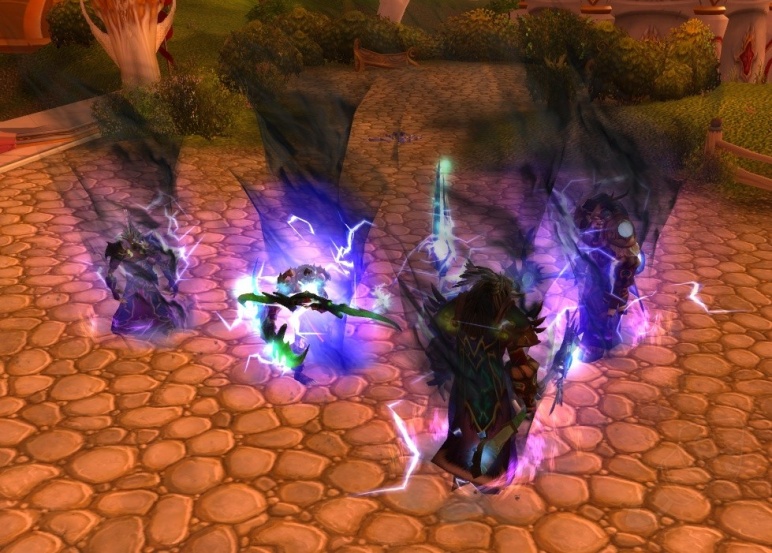
Sulfuras’s equip effect(s) still does more damage than Thori’dal’s equip effect does at the moment. Also, a burst proc of that nature is known to be inherently strong in PvP and the weapon itself might’ve seen use in farming or PvE as well, which says more than Thori’dal’s equip effect mostly turning Hunters into farmbots.
Atiesh’s equip effect(s) were incredible utility. It gave the raid an aura (unique for the four variations). The portal to Karazhan was just icing on the cake (and is still handy if you want to save time farming Karazhan).
Val'anyr’s proc scales. Also it was actually useful for healers (and still could be). The point is the proc is nice and definitely better than shooting magical arrows that are just aesthetic (and similar to an attack Hunters can do).
Shadowmourne has a very cool proc. It was incredibly strong back then and is still pretty strong now. Also the visual is great too – very appropriate for a weapon of its nature. It gets the best of both worlds.
Dragonwrath’s equip effect is very powerful (and has potential to scale). The use effect of turning into a Blue Dragon (with a “unique” model) that can fly around like a mount is an excellent perk too.
Fangs of the Father’s proc is somewhat similar to Shadowmourne’s, although it is specifically tuned for Rogues and has a nice visual effect to boot (and it might be able to scale, as 5 combo-point finishing moves for 6 seconds is good at any level of gear…). The use effect is a free slow fall too, which is helpful at times.

To conclude, Thori’dal’s original equip effect really just saved money and a bag slot. It’s the equivalent of having a weapon that removed reagent costs from spells (Soul Shards for Warlocks, for instance). Granted, it gave the option of having an alternative weapon in case a Hunter ran out of ammo in the middle of a raid but ultimately, when it comes down to it, it just meant Hunters only had to pay their repair bills like everyone else (although tanks had it really bad, but with ammo costs Hunters may have rivaled tanks in terms of cost to raid). The huge weapon damage margin was great, but as you’ll see in the next part, it wasn’t that helpful either.
To make things worse, the present-day equip effect is pretty much nothing. The visual and the weapon itself do look nice, I’ll give it that, but other weapons actually have some cool equip effects that do something to the enemy too or even special use effects (and have nice visuals).
Usefulness in PvE
With an amazing weapon damage range that Steady Shot, a core ability for Hunters (one could literally do dps as a Hunter with a 1-button macro), can directly scale off of, why was Thori’dal so useless in PvE? With the statements above taken into account, it was clear the weapon wasn’t useful coming into Wrath of the Lich King. Granted, some progressive guilds did have Hunters using Thori’dal but only until they got suitable upgrades, which could easily be gotten from Heroic dungeons, quests, or some of the bosses in Naxxramas.
The problem is that it had no usefulness during the Burning Crusade either. By the time a Hunter got it, their guild already finished the most difficult raid to date, meaning it would only be easier to farm raids the guild has probably already finished anyways. Keep in mind this was also before Heroic Raids were implemented, and because Thori’dal had minimal use in the following expansion, this just makes Thori’dal's time of implementation rather confusing.
Consider other legendaries. Thunderfury, for instance, was usable as a tank weapon up through a huge amount of Burning Crusade content (although to be fair this was because the proc generated way more threat than Blizzard probably intended and it was multi-target to boot). I am actually completely unsure about Sulfuras, but what I do know is that it was by far one of the strongest 2-handed weapons for a large amount of Vanilla WoW, but from what I hear, there weren’t exactly that many classes that could use it viably. Nonetheless, it was possible to use the weapon into Burning Crusade leveling and it was a Tier 1 legendary weapon (if anyone knows for sure how viable Sulfuras was, it would be good to hear).
Atiesh, from what I hear, was useful up until Tier 4, meaning that it survived the gear inflation that Burning Crusade brought, although this is probably due largely to the aura effects and the portal to Karazhan the staff provides (it also triggers an interesting lore-related line from Shade of Aran if you engage that boss with the staff). The Twin Blades were useful for a majority, if not the entire remainder of the Burning Crusade. Black Temple was released in 2.1, which left 3 whole major patches that the legendary weapon set could propagate and be used for content like Sunwell and Zul’aman (although technically it “survived” for one tier).
Val'anyr, (also) from what I hear, was usable up through Icecrown Citadel, although not many raiding guilds managed to finish one prior to Trial of the Crusader (but that’s another story…). Shadowmourne can arguably be considered as “useless” as Thori’dal, but there are a few differences. Firstly, Shadowmourne can be obtained before defeating the end boss of its tier, the Lich King (the final quest of the chain involves using Shadowmourne and killing the Lich King). Secondly, Heroic raids were implemented by then and Shadowmourne could be completed by any 25-man raiding guild actively progressing through Icecrown Citadel, meaning Shadowmourne could be used to progress through the Heroic version (or even Trial of the Grand Crusader). Finally, but not too importantly, Ruby Sanctum was introduced in the 3.3 major patch cycle, which was a brief (though disliked) raid.
Dragonwrath was introduced in the Tier 12 raid and even with the final tier of Cataclysm, it is a viable weapon and considered best in slot for casters. Fangs of the Father has a similar story as Shadowmourne except without the benefit of an addition single boss raid (but that doesn’t stop it from being useful in Heroic Dragon Soul).
Overall, Thori’dal is arguably one of the most inferior of the legendaries in terms of PvE usage. It was introduced at the end of an expansion’s life cycle and only really found use in raids the Hunter’s guild already has on farm to begin with. To make things worse, legendaries introduced after that also came during the end of an expansion’s life cycle had the benefit of being used in Heroic raids, meaning they found a niche (a pretty small one compared to some other legendaries) in PvE progression.
PvP Usage
If the fact Thori’dal had close to no use in PvE wasn’t disconcerting, the sheer lack of influence this weapon had on PvP as opposed to other legendaries (mainly ones that were released during Arena Seasons) is even more appalling. Just like in PvE, this weapon definitely had significant potential in PvP due to the high amount of damage a Hunter could deal with such a weapon. The problem, however, is somewhat related to issues that kept the weapon from having its potential unleashed on the PvE front.
So what was the problem? It was that it was released in the final tier of an expansion. Granted, there were other legendaries that worked out well (Shadowmourne and arguably, Fangs of the Father) even though they were released at the end of the expansion. This, however, was due to the weapons being well endowed and/or the fact the PvP season lasted for a prolonged amount of time or many more players managed to get the legendary, making it more of a “carry weapon.”
The problem is Thori’dal was severely lacking, especially in the latter fact. By the time achievements were introduced during the Wrath of the Lich King pre-patch, only 45 Thori’dals were in game over every single region (technically 44 since a Rogue got one of the 45). It might have been powerful, but it wasn’t about to have enough of an influence like other legendary weapons to increase Hunter arena representation, a sore spot for that particular class even up to present day (at high ratings the class has never gotten close to the 10% “average” representation mark). Furthermore, there was little to no complaining about Thori’dal from PvPers but a definitive slew of complaints about most of the other legendaries in competitive PvP (Twin Blades, Shadowmourne, and Dragonwrath especially).
Even Sulfuras, a Vanilla legendary, received some recognition for its usage in PvP, which was before arena was introduced. A Shaman named Unbreakable used it and was quite unbreakable indeed. Thunderfury also saw use, possibly due to the proc. Atiesh didn’t really see much use, though to be fair it probably suffered from the same issues as Thori’dal in that regard, which still only puts in on par in terms of “usefulness.”
Vala’nyr is the last weapon in question. It may have seen a bit of use on healers who could go a DPS spec (since dual specs were introduced by that point) and maybe healers (particularly ones that used plenty of direct healing like Paladins) used it to some degree as well. However, since I haven’t found much evidence supporting this theory, I’ll just tag it as “not so useful” (maybe someone else knows something about this?).
Overall, Thori’dal is at the very most on par with other PvP weapons in terms of usefulness. I could argue that since it was a weapon intended for a DPS class, and all other weapons given to and intended for DPS classes got “carry weapons” during the time arenas existed that Thori’dal’s uselessness is even greater, but even being on par is pretty significant given previous evidence regarding the weapon.
Conclusion
Thori’dal was a pretty cool weapon at first. It was a Hunter legendary (at last!) and there was plenty of hype over it despite the glaring flaws (such as lack of lore), with the assumption that would be filled in later on. The infinite ammo, at the time, was also appreciated, but mostly because I think Hunters were getting sick of their ammo system and having to use a quiver all the time (even though it was ultimately improved on and abolished later).
But then I realized how underwhelming the weapon was, how rare the weapon was at the time, and the loot drama related to it during the tier because of a failure to make the weapon exclusive to the class it was intended for (unlike the Twin Blades…). I found out it just didn’t have a good niche anywhere at all except maybe for farming or dailies (which I used it for during Wrath of the Lich King) and even then that niche was eliminated as well.
It has even reached the point that the weapon is now inferior or equal to an epic equivalent in the same tier, so even level 70 twinks are denied the ability to use a legendary weapon viably (I think Twin Blades, however, remains viable in that particular “end game”).
Ultimately, however, the purpose of this article isn’t about asking Blizzard to fix Thori’dal or anything unreasonable like that. That’s all said and done. Instead, I just wanted to raise awareness about how much of a failure this legendary was and hope that when the time comes (which should hopefully be in Mists of Pandaria), this doesn’t happen again. In fact, it shouldn’t happen to any class with any legendary ever again. Given how well they implemented legendaries since then, I am optimistic about that particular future.
 |
| Try saying "Holyarrow" in Thalassian. |
Subscribe to:
Posts (Atom)